Kabaddi
A raider crosses into the opponents' half, tags as many defenders as possible and returns — while the defenders try to hold them down. No ball, no equipment: just breath, speed and grip.
AT A GLANCE
- ERA
- Folk · ancient roots
- ORIGIN
- India
- PLAYERS
- 7 on court
- EQUIPMENT
- None
- PLAYING AREA
- 13 × 10 m
- DURATION
- 2 halves × 20 min
- GOVERNING BODY
- IKF
- OLYMPIC
- No
The court
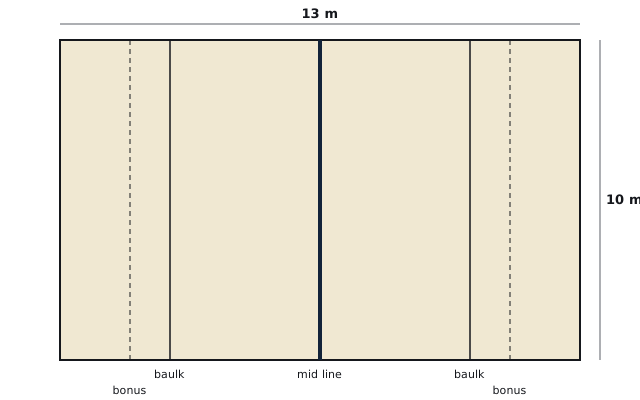
| Line | Where |
|---|---|
| Court | 13 × 10 m (men) |
| Mid line | Splits the two halves |
| Baulk line | 3.75 m from the mid line |
| Bonus line | 1 m beyond the baulk line |
| What happens | Points |
|---|---|
| Raider touches a defender and gets home | 1 per defender touched |
| Defenders stop the raider | 1 to the defending side |
| Raider crosses the bonus line (6+ defenders on court) | 1 bonus point |
| Whole team put out ("all out") | 2 extra points |
How a raid works
One raider enters the opposing half and must cross the baulk line. They try to touch defenders and get back over the mid line; defenders try to stop them. Touched defenders are out until their side earns them back.
Scoring in one line
Raiders score for each defender touched, defenders score for each successful tackle, and wiping out a whole team earns a 2-point bonus.
Where it came from
A rural team game played across South Asia for centuries in many local forms. Standard rules grew out of Indian versions in the 20th century.
Kabaddi today
A medal sport at the Asian Games since 1990. The Pro Kabaddi League, launched in India in 2014, turned it into a television sport.
Run a Kabaddi tournament
Brackets, fixtures and standings in your browser — 2 × 20 min.
FAQ
Is kabaddi in the Olympics?
No. Its biggest multi-sport stage is the Asian Games, where it has been a medal event since 1990.
How many players are on a kabaddi court?
Seven per side, with substitutes on the bench.
What is the difference between kabaddi and kho kho?
Both are Indian chase games with no ball. Kabaddi allows full tackles and has one raider at a time; kho kho is touch-only and passes the chase between seated players.