Sepak Takraw
Volleyball played with feet, knees, chest and head over a badminton-height net. Three per side, a woven ball, and no hands allowed.
AT A GLANCE
- ERA
- Folk · modern rules
- ORIGIN
- Southeast Asia
- PLAYERS
- 3 a side (regu)
- EQUIPMENT
- Woven ball, net
- PLAYING AREA
- 13.4 × 6.1 m
- DURATION
- Best of 3 sets
- GOVERNING BODY
- ISTAF
- OLYMPIC
- No
The court
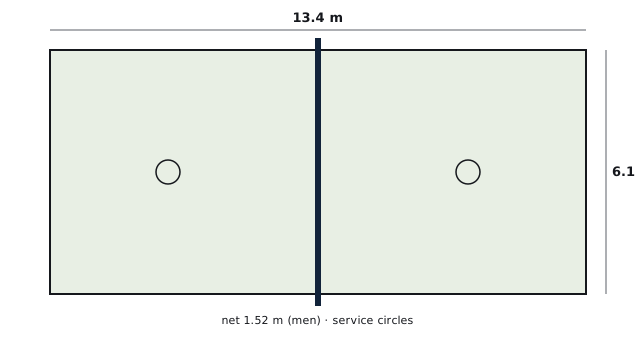
| Part | Size |
|---|---|
| Court | 13.4 × 6.1 m |
| Net height | 1.52 m (men), 1.42 m (women) |
| Service circles | One in each half |
| Rule | Detail |
|---|---|
| Every rally | 1 point (rally scoring) |
| Set | First to 21 |
| Match | Best of 3 sets |
| Touches | Up to 3 per side, no hands |
How a rally works
The server kicks the ball over the net from the service circle. Each side gets up to three touches with any part of the body except the hands and arms. The ball must not touch the ground on your side.
Scoring in one line
Rally scoring: every rally is a point, first to 21 wins the set, best of three sets wins the match.
Where it came from
Keep-up games with a woven rattan ball were played for centuries across Malaysia, Thailand, Indonesia, Myanmar and the Philippines under different names. A net version was standardised in the mid-20th century.
Sepak Takraw today
A fixture of the Asian Games and Southeast Asian Games, known for overhead bicycle-kick spikes. Thailand and Malaysia are the strongest nations.
Run a Sepak Takraw tournament
Brackets, fixtures and standings in your browser — Best of 3 sets to 21.
FAQ
Is sepak takraw in the Olympics?
No. It is played at the Asian Games and the Southeast Asian Games.
Can you use your hands in sepak takraw?
No. Players use feet, knees, chest and head; hands and arms are not allowed.
What does sepak takraw mean?
It combines the Malay word for kick (sepak) with the Thai word for the woven ball (takraw).